







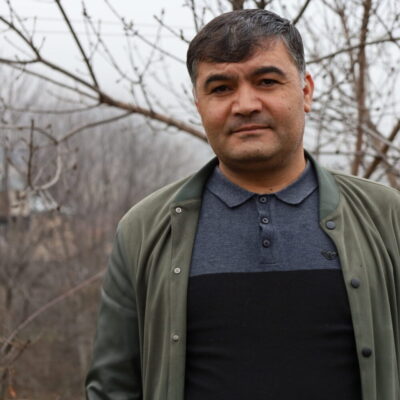
In the aftermath of the war, rebuilding one’s life is no easy feat. For Hayk Aslanyan, a partner of the “Modernizing Vocational Education and Training in Agriculture in Armenia” (MAVETA) project, the challenges of the post-war period have only reinforced his belief in the importance of farming and education.
From Family Legacy to a New Beginning
Aslanyan finds farming more than a profession—a part of his heritage.
“I’ve been involved in farming since my childhood. My grandfather was a farmer, and his efforts laid the foundation for our family’s farm in Artsakh. Unfortunately, after the war, he stepped away from farming. Like many others, we were forced to leave and resettle in Goris, my birthplace,” Aslanyan explains.
Despite the hardships, he refused to give up. “We had a cattle barn from the Soviet era in Goris that had been neglected. After the war, I focused on restoring it. It’s not easy, but step by step, I’m rebuilding what we lost,” he continues confidently.
A Path to Education
Hayk Aslanyan’s passion for agriculture led him to Goris State Agricultural College, where he now combines practical experience with formal education.
“Studying at the Armenian National Agrarian University in Yerevan wasn’t possible for me due to family and work commitments here in Syunik. When the Goris State Agricultural College introduced dual education programs in agriculture, I knew it was my chance. It allowed me to strengthen my practice with theoretical knowledge,” Aslanyan highlights.
Dual education—a combination of classroom instruction and on-the-job training—has become a cornerstone of Aslanyan’s learning experience.
“Students in dual education benefit from both worlds. Teachers provide theoretical knowledge, while farmers like myself offer hands-on training. The better equipped and organized the farm, the more meaningful the practical experience becomes,” he explains.
The Role of MAVETA
Hayk Aslanyan has joined the MAVETA project recently. Being involved as both an apprentice and an employer, he says it creates opportunities not only for students, but also for educators and farmers.
“It’s encouraging to see how such projects can bridge education and practical work in agriculture,” he emphasizes.
When asked if farming is an attractive path for young people, Aslanyan’s answer was clear: passion is key.
“Agriculture is a lifestyle. If you don’t love it, you won’t succeed. But for those who truly care about it, there’s immense satisfaction in working hard and seeing the fruits of your labor.”
He also has a message for those hesitant to change the field and pursue agriculture later in life. “Education has no age limit. The longer we live, the more we learn. If someone hasn’t found success in another field but loves agriculture, they should embrace it geniunely. With love and dedication, everything will work out,” sum ups Hayk Aslanyan.
The MAVETA project is funded by a broad coalition of international and local organizations led by the Swiss Agency for Development and Cooperation (SDC), including the Austrian Development Agency, the German Ministry for Economic Cooperation and Development (BMZ), the Government of Armenia, the Swiss Church Aid (HEKS/EPER) NGO, Izmirlian Foundation, the Strategic Development Agency (SDA) NGO and Vanand Agro CJSC.
The project’s implementing partners are the GIZ and HEKS/EPER with the involvement of SDA and the School of Agricultural, Forest and Food Sciences at the Bern University of Applied Sciences (HAFL).